E-commerce fraud costs businesses billions annually, with a surge in fraudulent activities posing challenges for merchants. ZIP code data has become a powerful tool to detect fraud by identifying inconsistencies in billing, shipping, and IP locations. Here's how it works:
- Mismatch Detection: Fraudsters often use stolen credit cards but fail to match ZIP codes with correct addresses. Geographic mismatches, like an IP address in Lagos and a billing ZIP in Berlin, are red flags.
- Freight Forwarding Risks: High-risk ZIP codes, such as those in Miami, are often linked to fraud due to freight forwarding schemes for stolen goods.
- Real-Time Validation: ZIP code geocoding APIs help validate addresses, ensuring consistency between entered data and actual locations.
- Behavioral Patterns: High-velocity orders to the same ZIP code or mismatched time zones between IP and billing addresses indicate potential fraud.
Fraud detection systems integrate these insights using tools like ZIP code geocoding APIs, IP geolocation, and automated risk scoring. These methods help businesses reduce chargebacks, improve customer trust, and identify fraud patterns effectively.
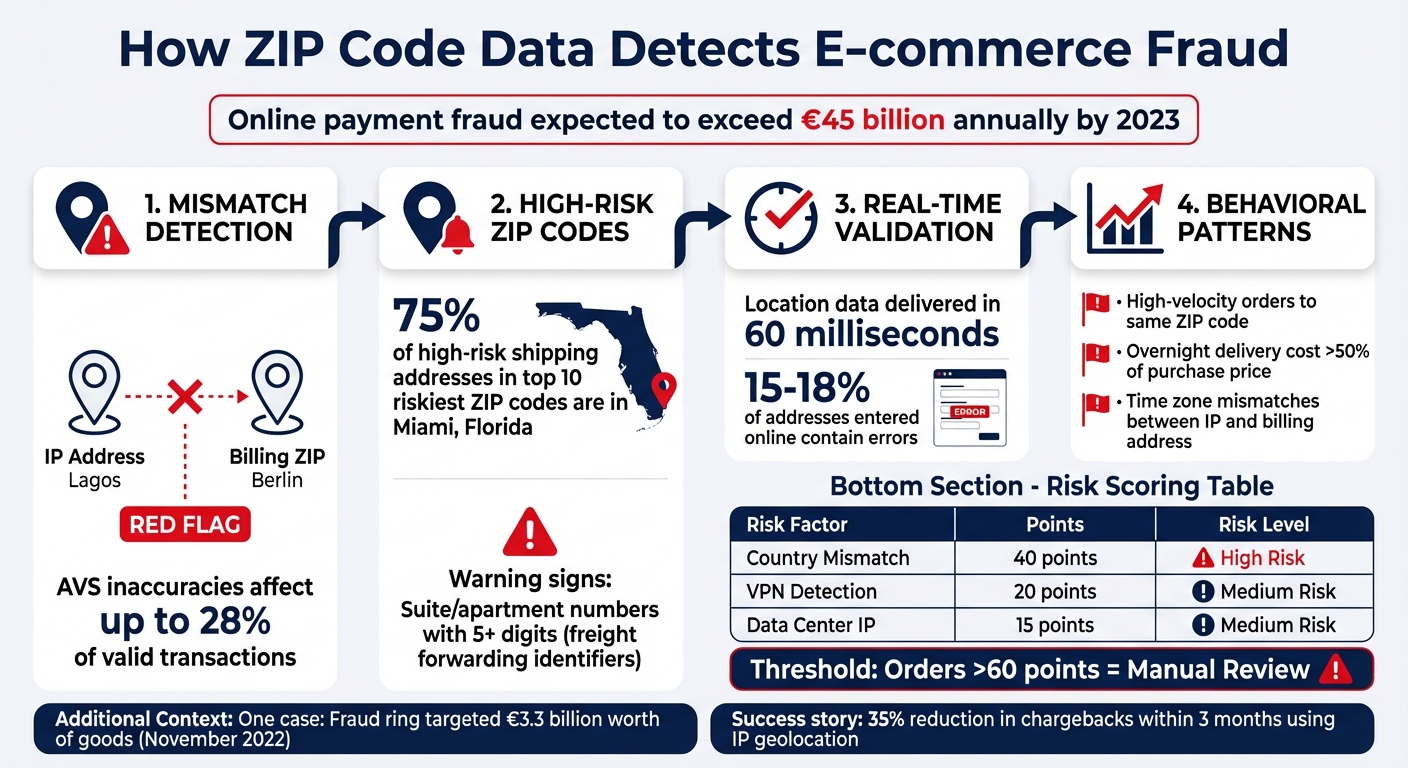
How ZIP Code Data Detects E-commerce Fraud: Key Methods and Red Flags
Module 2 Lecture 8: Fraud Detection Tools and Techniques - Safeguarding Payments from Fraud
sbb-itb-823d7e3
How ZIP Code Mismatches Reveal Fraud Patterns
Pinpointing fraud often hinges on accurate geocoding. When cybercriminals misuse stolen credit card details, they rarely possess the complete address information of the cardholder. This gap creates inconsistencies in ZIP code data that can flag suspicious transactions. Recognising these patterns is a key step in designing robust fraud detection systems.
For example, a transaction might display a billing ZIP code from Berlin, but the IP address could trace back to Lagos, Nigeria. Similarly, a shipping address might pair a valid German postal code with a fictitious street name. These geographic mismatches can highlight fraud that basic validation systems might miss.
Red Flags in ZIP Code Data
Address Verification Service (AVS) checks are designed to compare the ZIP code entered during a transaction with the one registered at the issuing bank. A mismatch often signals potential fraud. However, AVS inaccuracies can affect up to 28% of valid transactions, making it essential to distinguish between genuine fraud and simple errors in data entry.
"A mismatch [in ZIP/postal code] can flag a transaction as high risk." - Waqas, Cybersecurity Journalist, Hackread
Several warning signs can indicate fraud, such as valid ZIP codes paired with non-existent street names, incomplete address information (like missing apartment numbers), or discrepancies between the IP address location and the billing or shipping ZIP code. Large geographic gaps between these points are particularly telling, as fraudsters often use VPNs or proxies to disguise their real location.
Freight forwarding addresses are another red flag. Research shows that 75% of high-risk shipping addresses linked to the top ten riskiest ZIP codes are in Miami, Florida. These addresses often include unusually long suite or apartment numbers - five digits or more - that serve as identifiers for freight forwarding companies while appearing to be residential.
Common Fraudster Techniques
Fraudsters continuously adapt their methods to evade detection. One common tactic is "Master Manipulation", where they make subtle changes to address details - like altering letters in familiar street names - to bypass automated fraud filters that track high-velocity orders sent to the same ZIP code.
Another technique involves geographic exploitation. Fraudsters may select a country like the United States to unlock shipping options or promotions, while providing a ZIP code from a different country. This allows them to access region-specific benefits or bypass restrictions.
"Fraudsters commonly worked to get around retailers' preference for a billing and delivery address match by initially having an order shipped to the legitimate cardholder's address, before redirecting the package." - Mike Cassidy, Head of Storytelling, Signifyd
Freight forwarding patterns also stand out. Fraudsters often use ZIP codes near major coastal ports - such as Miami, Houston, Seattle, and Newark - to consolidate stolen goods for international shipment. Meanwhile, the billing ZIP code remains tied to the victim's domestic address. In one case, a fraud ring using address manipulation targeted €3.3 billion worth of goods from U.S. merchants in November 2022 alone.
High-velocity order patterns are another telltale sign. Multiple orders shipping to the same ZIP code within a short period often point to coordinated fraud rings. When combined with expedited shipping requests - where overnight delivery costs exceed 50% of the purchase price - it’s a clear indicator of fraudsters rushing to receive goods before the cardholder reports the theft.
These patterns highlight the importance of real-time ZIP code geocoding, which will be discussed further in the next section.
Using ZIP Code Geocoding APIs for Fraud Detection
Tools like Zip2Geo (https://zip2geo.dev) make it possible for developers to turn ZIP codes into precise geographic coordinates and place names. This kind of location data is crucial for validating addresses and spotting fraudulent transactions as they happen. By integrating ZIP code geocoding APIs, businesses can add an extra layer of verification to ensure geographic consistency in real time.
These APIs work by converting postal codes into verified geographic details through processes like parsing, normalization, and matching. The data returned often includes city names, state abbreviations, county information, time zones, and daylight saving indicators. Impressively, these systems can deliver location data in just 60 milliseconds. By comparing input data against reliable datasets (like USPS CASS™ or Canada Post), they confirm whether a ZIP code is active and correctly formatted. Advanced versions even offer fraud-specific features, such as "Residential/Commercial" classification and "ZIP+4" precision. For example, if a residential purchase is being shipped to a commercial address, this could signal fraudulent activity.
"15% of addresses entered online contain errors, which can lead to billions in lost revenue annually." - USPS
Real-Time Address Validation
To combat fraud, developers should incorporate geocoding APIs directly into checkout forms. These APIs can validate ZIP codes and addresses as customers input them, preventing fraudulent entries from reaching the payment stage. A smart way to implement this is by triggering an API call when users click "Next" or "Continue" during the checkout process, rather than waiting until after the transaction is completed.
A "Fix, Confirm, Accept" approach works well here: accept high-quality matches, prompt corrections for low-quality inputs, and confirm minor discrepancies. This workflow not only reduces the risk of fraud but also keeps cart abandonment rates low.
Another layer of protection comes from automated confidence scoring. APIs can assign scores based on the accuracy of the address at various levels, such as building, street, or city. By setting thresholds (e.g., >0.9 for automated processing and >0.6 for manual review), businesses can balance fraud prevention with operational efficiency. It's worth noting that around 18% of addresses entered online contain errors like typos or invalid codes.
Cross-Checking Geographic Data
Real-time validation is just the first step. Cross-checking geographic data can further enhance fraud detection. Geocoding APIs are capable of identifying mismatches between ZIP codes, cities, states, and countries, which can help uncover inconsistencies in customer information. For instance, a fraudster might use a valid ZIP code but pair it with a fake street address to bypass basic validation checks.
Another effective tactic is cross-referencing the user’s IP geolocation with the billing and shipping ZIP codes provided. Advanced IP geocoding APIs can even include a provider field, revealing whether a request originates from a data center or VPN - both common tools for fraudsters. Considering that over 30% of internet users access the web via VPNs monthly, analyzing these details is critical.
"An IP geolocated to New York but operated by 'DigitalOcean' or 'NordVPN' tells you more about the request's nature than the city name alone." - InfoSniper
Time zone alignment offers yet another layer of verification. By mapping time zones, geocoding APIs can compare a user’s IP-based location with the billing address. For example, a transaction originating from an IP address in Lagos, Nigeria (GMT+1) but claiming a billing address in Berlin (GMT+1) might initially seem consistent - until the system detects that the request came through a known VPN provider. This kind of cross-checking ensures a deeper level of fraud detection.
Adding ZIP Code Verification to E-commerce Systems
Integrating ZIP code verification into your e-commerce platform involves three crucial steps: capturing accurate addresses, validating them in real time, and cross-checking these details against actual locations. This layered approach not only enhances fraud prevention but also ensures a smooth and reliable checkout experience for genuine customers.
One tool to consider is Zip2Geo's API, which converts ZIP codes into precise geographic data. This ensures that both billing and shipping addresses are trustworthy, bolstering your fraud detection efforts.
Verifying Billing and Shipping Addresses
To streamline the checkout process and reduce errors, use Place Autocomplete. This feature suggests valid addresses as customers type, speeding up data entry and minimizing mistakes. Following this, an Address Validation API can confirm the completeness and formatting of the entered address. Displaying the validated address on a map further reassures customers about the accuracy of the delivery process.
When handling API responses, categorize them into three outcomes:
- Accept: High-quality addresses that can move directly to payment after standardization.
- Confirm: Addresses requiring minor corrections, such as adding a ZIP+4 code, should prompt users for approval via a modal.
- Fix: Low-quality addresses that need specific fields to be re-entered.
This workflow reduces the risk of fraudulent entries while keeping the process user-friendly. Instead of outright blocking checkout due to validation issues, introduce a two-strike rule: customers get two attempts to enter a valid address. If they fail on the second attempt, allow them to proceed but flag the order for manual review. This ensures flexibility for common errors without compromising security.
"Zip codes are handled differently in almost every country. We provide an efficient data layer to help you validate and normalize zip codes." - Zipcodestack
For security, always proxy API requests through your backend server to protect your API keys. To optimize costs and reduce latency on high-traffic sites, implement a cache (e.g., using Redis) with a 24–48 hour time-to-live (TTL) for repeated lookups, as postal data rarely changes.
Matching IP Location with ZIP Code Data
Beyond address validation, comparing IP location data with provided ZIP codes adds another layer of fraud detection. Use an IP Geolocation API to determine the user's current postal code based on their IP address. Then, check for discrepancies between this data and the billing or shipping ZIP codes. While country-level IP geolocation is highly reliable (95–99%), regional accuracy drops to 55–80%, and postal code accuracy ranges between 30–60%. For this reason, treat IP-derived ZIP codes as a supplementary signal rather than a definitive fraud indicator.
Pay attention to the "provider" field in the IP geolocation data. Orders originating from data centres (e.g., AWS or DigitalOcean) rather than residential ISPs are statistically more likely to be fraudulent. Advanced APIs can also detect VPNs, Tor nodes, and proxies - tools often used for location spoofing. With over 30% of internet users accessing the web via VPNs monthly, this capability is vital.
Instead of outright blocking orders based on mismatches, implement a risk scoring system. For example:
- Assign 40 points for a country mismatch between the IP and billing address.
- Add 20 points for VPN detection.
- Include 15 points for a data centre IP.
If the total score exceeds a threshold (e.g., 60 points), flag the order for manual review or trigger multi-factor authentication. This scoring method minimizes false positives while catching genuine fraud attempts.
Here’s a breakdown of resolution levels, accuracy rates, and their best use cases:
| Resolution Level | Accuracy Rate | Recommended Use Case |
|---|---|---|
| Country | 95–99% | Geo-fencing, compliance, broad fraud detection |
| Region/State | 55–90% | Tax calculations, regional targeting |
| City | 50–80% | General localization, analytics |
| Postal Code | 30–60% | Rough area estimation; unsuitable for precise blocking |
Keep in mind that mobile carriers often use Carrier-Grade NAT (CGNAT), which can assign thousands of users to a single gateway in a different city. This makes city-level ZIP code matching less reliable for mobile users. Adjust your risk scoring to account for this, ensuring legitimate mobile shoppers aren't unfairly penalized.
Creating Fraud Detection Systems with ZIP Code Data
An effective fraud detection system does more than just validate addresses - it identifies patterns and automates decisions to block fraudulent transactions. By integrating tools like the Zip2Geo API, which translates ZIP codes into precise geographic coordinates and place names, developers can enhance both real-time checks and historical analysis to stop fraud before it happens.
The backbone of such a system is middleware validation. Using backend middleware (like Node.js or FastAPI) ensures that ZIP-to-IP consistency is verified in real time, preventing fraudsters from bypassing frontend checks - something skilled attackers can easily do.
Another key feature is impossible travel detection. By monitoring IP velocity, you can track how quickly a user moves between ZIP codes or regions.
"If a user logs in from New York and then appears in London 30 minutes later, you know something's off. By calculating the time and distance between logins, you can spot 'teleporting' accounts" - Fingerprint
This approach is particularly effective at detecting compromised accounts accessed from multiple locations at the same time.
To keep your system accurate, ensure your API updates IP-to-ZIP mappings frequently - ideally daily or weekly. These updates are vital for maintaining reliability and setting the stage for deeper historical analysis, which we'll explore next.
Tracking Fraudulent ZIP Codes and Patterns
Maintaining a dynamic "hot list" of high-risk ZIP codes, freight forwarder addresses, and P.O. boxes is essential for flagging suspicious transactions. Fraud often clusters in coastal cities and shipping hubs, such as Miami, Houston, Seattle, and Newark.
Keep an eye on address velocity by tracking how many orders are sent to the same ZIP code in a short time. A sudden spike in orders to one address is a major warning sign. Similarly, shipping addresses with suite or apartment numbers containing five or more digits are often linked to freight forwarding services used in international fraud schemes.
Fraudsters also exploit ZIP-to-street mismatches by pairing valid ZIP codes with fake street addresses to bypass standard validation systems. Cross-referencing ZIP codes with actual street data using CASS-certified datasets can reveal these inconsistencies, reducing fraudulent chargebacks by up to 35% within months.
Train your support team to flag accounts that modify shipping ZIP codes or delivery speeds (like switching to overnight delivery) after placing an order. These changes are common tactics for redirecting goods to untraceable locations.
"Fraudsters, who need to evade detection and efficiently resell stolen goods, leave traces in the shipping addresses they use" - Miguel Atienza, Director of Product and Marketing at MaxMind
Building on these insights, the next step is to formalize automated rules to streamline fraud detection.
Setting Up Automated Fraud Rules
To simplify risk evaluation, create a weighted scoring system that assigns points to various anomalies. For instance, give 30 points for a ZIP code mismatch, 50 points for VPN usage, and 40 points for a country mismatch between the IP and billing address. Orders that exceed a certain score (e.g., 60 points) can be flagged for manual review or require additional authentication.
| Check Type | Logic/Anomaly | Risk Level | Points |
|---|---|---|---|
| Country Mismatch | IP Country ≠ Billing Country | High | 40 |
| Distance Anomaly | Shipping ZIP > 500 km from IP Location | Medium | 20 |
| Velocity Check | Location change > 800 km/h | High | 50 |
| Connection Type | IP identified as VPN, Proxy, or Tor | Medium/High | 50 |
| Address Type | Shipping address is a freight forwarder | Medium | 30 |
Geofencing is another powerful tool. Set automated rules to block or require extra verification for transactions from high-risk countries or ZIP codes with a history of fraud. Keep in mind that mobile network ZIP code data is accurate within 5–10 kilometres, while residential broadband typically only narrows down to the city level. Adjust risk scoring accordingly for mobile users on Carrier-Grade NAT (CGNAT), as they may appear to be in different cities than their actual location.
Incorporate security metadata into your system using API flags like is_vpn, is_proxy, and trust_score. These help identify VPNs, Tor exit nodes, and proxies, which fraudsters often use to mask their real location. Transactions originating from data centres (e.g., AWS or DigitalOcean) rather than residential ISPs are also more likely to be fraudulent.
Adopt a "fail-closed" strategy, blocking transactions when geolocation data can't be verified in high-risk regions. For low-risk areas, a "fail-open" approach may be more user-friendly.
"Fraud detection powered by IP geolocation allows for real-time analysis of transactions. Businesses can assess the legitimacy of a transaction as soon as it is initiated rather than relying on post-transaction reviews" - Arvind Rongala, CEO of Edstellar
Lastly, ensure your system supports both IPv4 and IPv6 addresses. Many older databases struggle with IPv6, giving fraudsters an opportunity to exploit newer protocols. With online payment fraud expected to exceed €45 billion annually by 2023, covering all IP formats is essential for staying ahead.
Conclusion
ZIP code data is a powerful tool for developers aiming to combat e-commerce fraud. By validating addresses as they’re entered, cross-referencing geographic coordinates with IP locations, and identifying high-risk patterns, you can catch fraudsters who rely on fake or mismatched address details. With online payment fraud projected to surpass €45 billion annually, these methods are crucial.
To strengthen your defence, layer multiple signals. Pair ZIP code geocoding with tools like IP intelligence, velocity checks, and automated risk scoring. For example, one platform successfully reduced chargebacks by 35% in just three months by integrating IP geolocation. Solutions such as Zip2Geo simplify this process, offering RESTful API endpoints that convert ZIP codes into precise geographic coordinates in milliseconds. This makes real-time validation at checkout both efficient and seamless, especially when combined with automated risk scoring systems.
Start with the basics: real-time address validation and IP-to-ZIP cross-checking. As your fraud prevention strategy matures, incorporate advanced measures like automated fraud rules, geofencing, and analysis of historical patterns. Considering that approximately 15% of online addresses contain errors, even simple validation can save significant costs from failed deliveries and unnecessary shipping expenses.
FAQs
How accurate is IP-to-ZIP matching for fraud detection?
IP-to-ZIP matching can help spot fraud, but it’s not foolproof. IP geolocation provides useful location data, but its accuracy can be affected by things like VPNs, proxies, or outdated databases. Fraudsters often disguise their real locations, which can lead to mismatches. Solutions like Zip2Geo can offer more precise geodata, but relying solely on IP-to-ZIP isn’t enough. It works best when paired with other tools, such as contextual analysis and multi-layered security measures, to improve overall reliability.
How can I reduce false positives from AVS ZIP mismatches?
To minimise false positives caused by AVS ZIP mismatches, implementing real-time address verification can be a game-changer. This process corrects issues like misspellings or incorrect ZIP codes on the spot, reducing unnecessary transaction declines.
Understanding and correctly interpreting AVS response codes is another crucial step. By doing so, you can create fraud rules that are precise and effective, ensuring legitimate transactions aren’t mistakenly flagged as fraudulent.
For cross-border transactions, incorporating geographic risk assessment adds another layer of accuracy. This approach helps balance the need for fraud prevention with maintaining a seamless customer experience, especially when dealing with international payments.
When should I flag a ZIP code as high risk in my store?
Flagging a ZIP code as high risk can be crucial in combating fraud, especially in e-commerce. ZIP codes tied to addresses near shipping ports or freight forwarders are often associated with fraudulent activities. Another red flag is when the ZIP code doesn't match other address details, such as the city or state. Spotting and resolving these inconsistencies can go a long way in preventing suspicious transactions and protecting businesses.